
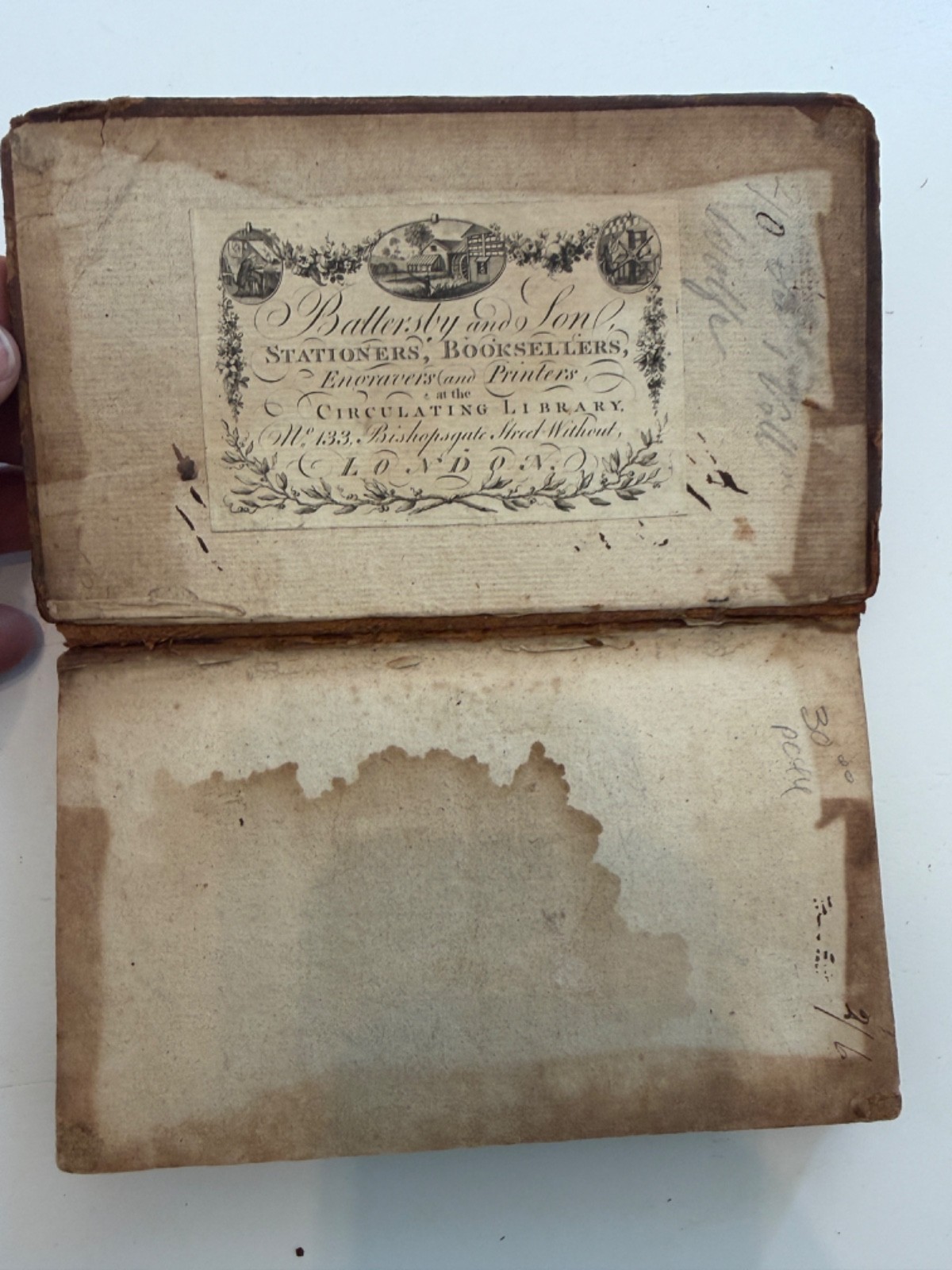


Rare handsome survival with exceptional evidence of early circulating-library
$ 0.53
Description
Rare handsome survival with exceptional evidence of early circulating-library. Dr. Goldsmith’s Roman History, Abridged by Himself for the Use of Schools. Second edition. Contemporary sheep, spine neatly relaid preserving portions of the original backstrip. GOLDSMITH, Oliver. Dr. Goldsmith’s Roman History, Abridged by Himself for the Use of Schools. Second edition. London: Printed for W. Owen, near Temple-Bar; L. Davis, in Holborn; G. Leigh and J. Sotheby, in York-Street, 1789. 8vo. Engraved frontispiece depicting “Faustulus delivering Romulus & Remus to his Wife Laurentia to nurse.” Contemporary sheep, spine neatly relaid preserving portions of the original backstrip. Lacking final leaf of advertisements only; text complete. General wear, scattered foxing and staining, old inscriptions and calculations to endpapers, but a handsome survival with exceptional evidence of early circulating-library use. An evocative late eighteenth-century school edition of Oliver Goldsmith’s immensely popular Roman History, made especially desirable by the striking engraved trade label of the London circulating library and bookselling establishment of Battersby and Son, Stationers, Booksellers, Engravers and Printers, at the Circulating Library, No. 133 Bishopsgate Street Without, London. The elaborate engraved label, adorned with pastoral and commercial vignettes, survives beautifully on the pastedown and offers a vivid glimpse into the world of Georgian popular reading culture. Circulating libraries formed the backbone of literary life in eighteenth- and early nineteenth-century England before the rise of public libraries. Through establishments such as Battersby & Son, books passed through the hands of clerks, merchants, apprentices, governesses, and aspiring intellectuals who could not afford to purchase substantial libraries of their own. Bishopsgate, one of the busiest commercial thoroughfares entering the City of London, was precisely the kind of district where ambitious readers and young professionals sought access to fashionable literature, classical histories, educational works, and novels. The survival of such a refined and highly decorative circulating-library label in an unrestored contemporary binding is increasingly uncommon, particularly in provincial educational works that were often read to pieces. The volume retains the atmosphere of a heavily used Georgian lending-library book, complete with contemporary ownership inscriptions, reader calculations, and signs of repeated handling across generations. A charming and tangible relic of London’s pre-public-library reading culture, linking Goldsmith’s educational classic to the bustling commercial and literary life of Georgian Bishopsgate.


